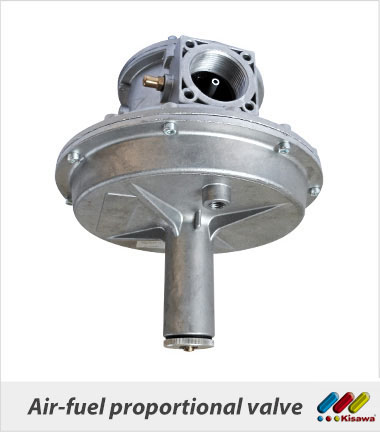
How to select an industrial proportional valve for a gas train
Selecting an industrial proportional valve for a gas train is more complex than choosing a simple on/off valve—you’re selecting a precision control element that directly affects combustion stability, safety, and efficiency.
Here’s a practical, engineering-focused selection guide used in combustion systems:
1. Define the control objective (FIRST step)
Ask: What exactly should the valve control?
-
Flow control → burner capacity modulation
-
Pressure control → stable downstream pressure
-
Air–gas ratio control → combustion optimization
Proportional valves can regulate multiple variables, but you must define the primary one first
👉 In gas trains:
-
Most common: flow modulation (linked to burner load)
-
Sometimes: pressure control (with regulator combination)
2. Determine flow capacity (Cv / Kv sizing)
This is the most critical sizing parameter.
-
Use:
-
Max flow rate (Nm³/h or SCFH)
-
Allowable pressure drop (ΔP)
-
Gas type (specific gravity)
-
Typical formula:
-
Kv or Cv must match system demand (not too big or small)
👉 Engineering rule:
-
Design valve for 1.1–1.5 × maximum flow
-
Best control when valve operates at 15–85% stroke
⚠️ Mistakes:
-
Undersized → pressure loss, unstable flame
-
Oversized → poor modulation accuracy
3. Check pressure conditions
You must evaluate:
-
Inlet pressure (P1)
-
Outlet pressure (P2)
-
Differential pressure (ΔP)
Key rule:
-
Valve pressure rating ≥ 1.25–1.5 × max system pressure
👉 In gas trains:
-
Often paired with a regulator upstream
-
Proportional valve handles fine modulation, not large pressure drops
4. Select valve type (very important)
a) Direct-acting proportional valve
-
Best for:
-
Small flow
-
Fast response
-
-
Limitation: low capacity
b) Pilot-operated proportional valve
-
Best for:
-
Large industrial burners
-
High flow gas trains
-
-
Needs minimum ΔP to operate
👉 Industrial gas trains typically use:
➡️ Pilot-operated type for stability and capacity
5. Choose control signal & compatibility
Ensure compatibility with your burner control system (BMS/PLC):
Common signals:
-
0–10 V
-
4–20 mA
-
PWM / fieldbus (advanced systems)
👉 Must match:
-
Controller output
-
Position feedback (if closed-loop)
6. Define control performance requirements
Especially important for combustion systems:
-
Response time (fast load changes)
-
Repeatability / hysteresis
-
Resolution (low-fire stability)
Dynamic systems (like burners):
-
Require continuous modulation and high cycling durability
7. Select flow characteristic curve
This affects control behavior:
-
Equal percentage (MOST COMMON)
→ Best for burners with wide turndown ratio -
Linear
→ Stable systems with small variation
👉 Gas burners almost always use:
➡️ Equal percentage characteristic for smooth flame control
8. Check gas compatibility & materials
Important for safety and durability:
-
Natural gas / LPG / biogas / hydrogen blends
-
Seal materials:
-
NBR / FKM / EPDM (depending on gas)
-
Also consider:
-
Clean vs contaminated gas
-
Filtration upstream
9. Safety & certification (CRITICAL)
Gas train valves must comply with:
-
EN 161 / EN 88 (Europe)
-
ATEX (hazardous area)
-
SIL / functional safety (if required)
👉 Also ensure:
-
Fail-safe position (normally closed) for gas systems
10. Environmental & installation conditions
Evaluate:
-
Ambient temperature
-
Vibration (industrial furnaces)
-
IP protection (dust, moisture)
-
Space / mounting type (inline, manifold)
11. Integration with gas train
A proportional valve is not standalone. It works with:
👉 In a gas train, it usually sits:
➡️ Downstream of safety valves, upstream of burner
12. Typical selection workflow (summary)
-
Define control variable (flow/pressure)
-
Calculate max flow → Cv/Kv
-
Check pressure range
-
Choose pilot vs direct type
-
Select signal type
-
Confirm control accuracy & response
-
Verify certifications (EN/ATEX)
-
Match materials to gas
-
Check installation constraints
Practical example (industrial burner)
-
Gas: Natural gas
-
Flow: 500 Nm³/h
-
Pressure: 300 mbar inlet
-
Requirement: modulating burner
👉 Recommended:
-
Pilot-operated proportional valve
-
Equal percentage characteristic
-
4–20 mA control
-
Kv sized ~600–750 Nm³/h
- Phone: 86 185 6630 3837
WhatsApp: 86 185 66303837
Email: ekelairn@gmail.com
Web.: http://ekgas.com
Leave a comment